Here is the translation of the provided text into English: There is a growing divergence: the economy is stable and improving, but employment is becoming increasingly difficult.
For macroeconomics, the rhetoric has always been "stable and improving," "the situation is very good," and so on.
For example, the headline from Xinhua News Agency: "Economic Operation Overall Stable, High-Quality Development Solidly Promoted - Focusing on the Trend of China's Economy in August."
Additionally, some economic indicators are also thriving or very stable.
However, the micro-level experience of the common people is completely different; they do not feel the economy is improving, but instead, the most direct aspect of employment has become more difficult.
After being suppressed for three years, places like Zibo barbecue and Guizhou village supermarkets have successively become popular, and domestic consumption did indeed rebound.
Employment related to the common people such as catering, tourism, and accommodation also improved for a while.
But soon, the wave of concentrated consumption passed, everything returned to normal, and then everyone stopped consuming, making it difficult for street shops related to people's consumption.
Employment for college students is also very difficult.
In a class of 22 English majors at a certain school, no one was employed, causing the counselor to "go crazy" in the group: "I inform everyone in English Class 2 who do not cooperate with the employment work, I don't know if I have offended you personally, or if the school has wronged you.
I don't believe that out of 22 students, none are employed.
Your irresponsible and uncooperative behavior is really infuriating me..." Employment for those with master's and doctoral degrees is even more difficult.
The recruitment threshold has obviously been raised to a higher level.
Before, a master's degree was required, now a doctorate is needed; before, a bachelor's degree was required, now a master's degree is needed.
Even so, out of 10 doctors, at most 3 are employed.
Now everyone has a perception that whether you are young or middle-aged, whether you are in a first-tier city or a second-tier city, once unemployed, it is basically impossible to find a job.
Now the libraries are full of unemployed people, studying diligently, hoping to improve their competitiveness in the job market.
It is necessary to understand a problem: the current situation is not about disliking the job, not about not being able to take off the long shirt, but there are really not too many job opportunities.
Let's look at the statistical data: 1.
The change in our surveyed unemployment rate is very small, and many people feel that there might be a problem with the statistics.
Regardless of whether the economy is good or bad, the numbers have not changed much.
Even so, our current unemployment rate is far higher than that of the United States and Japan.
How should we view this data comparison?
Our media has been saying that the U.S. economy is going to decline, the U.S. can't hold on and needs to lower interest rates, and the U.S. labor market has a big problem.
But upon comparison, the U.S. unemployment rate is lower than ours, while our economy is "stable and improving" and "high-quality development."
Japan, let alone, has a very strong economy, and the labor market is in short supply.
It is very easy to find a job in Japan.
2.
In August, the unemployment rate for young people in China soared to 18.8%.
Before, this data was not announced for several months due to the high surge, and later it was announced again after adjusting the statistical approach, but even after adjusting the statistical approach, this number has come up again.
Compare this with the situation in Japan after the real estate bubble burst, where the unemployment rate for young people also soared, reaching a peak of 13.2%.
Even so, the unemployment rate for young people is far lower than our current level.
Note that Japan's statistical data also includes college students, while our data in August does not include college students.
If the two data are unified, the unemployment rate for young people in our country is more terrifying than that in Japan at that time.
How should we view this difference?
At that time, Japan was facing a real estate market bubble, the economy entered a great depression, and the whole country was facing difficulties.
But our approach is still that the economy is stable and improving.
Why should we pay attention to employment?
Because employment is not only an economic issue but also a livelihood issue.
Economic development should allow the vast majority of the people to enjoy the benefits, not just a small group of people.
There are two ways for the vast majority of people to enjoy the benefits: one is direct transfer payments, improving the welfare mechanism, and supporting a group of people with the dividends of the times.
The United States is this model.
A small group of top talents lead the forefront, a large group of middle-class people work hard, and a small group of "waste people" lie flat.
The U.S. government uses means such as "taxes" and "relief" to support this group of unemployed or lying flat people with the wealth created by the elite class.
The more wealth the elite class creates, the higher the living standards of the bottom "waste people," and economic development also takes care of the vast majority of people.
The other way is to give them work, to work in lieu of relief, and to enjoy the dividends of the times, which is the choice of the vast majority.
Generally speaking, when the macroeconomy is good, employment will also improve, and it is rare to have a divergence.
Therefore, the Federal Reserve's key indicator for measuring the good or bad economy is employment.
As long as employment is not good, the Federal Reserve will consider lowering interest rates.
It is rare for the macroeconomy to diverge from employment.
However, in the past two years, we have often diverged.
How to understand the divergence between macroeconomics and employment?
If there is no problem with the quality of economic data, then the problem may appear in the structure.
1.
In our article "The 'Hardest Employment Season' Ever?
Don't Let Low-End Manufacturing Run Away!"
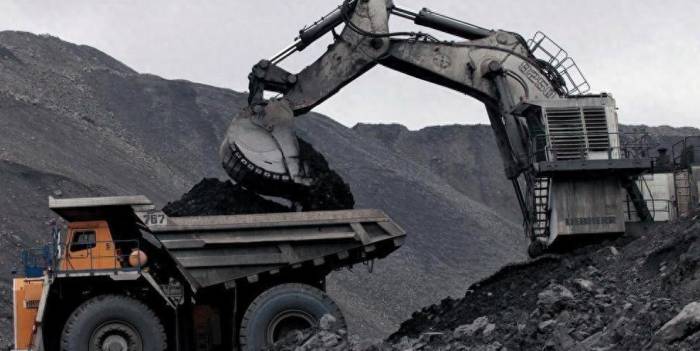
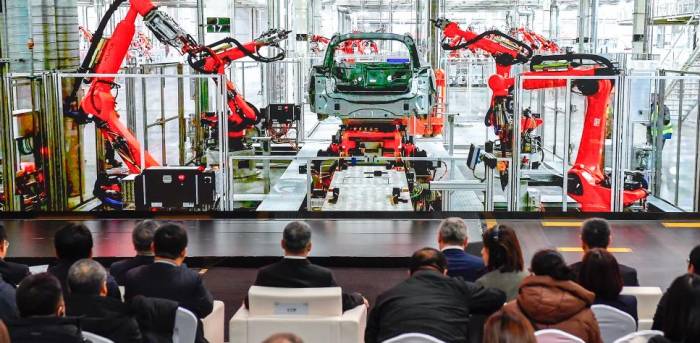
we talked about a logic: high-end industries lead the future, and low-end industries support employment.
Compared with high-end industries, low-end industries need more workers for the same output value.
That is, they absorb relatively more employment.
And high-end industries mean that for the same output value, fewer workers are needed.
The more the manufacturing industry is upgraded, the higher the unit output value, and the fewer employees are needed for the same output value.
If we develop high-end industries on a large scale and ignore low-end industries, it will make the economy look very good overall, but under the macroeconomic prosperity, there must be a loss of employment opportunities for individual micro entities.
2.
The vast majority of the people are basically engaged in low-end service industries, such as catering, tourism, accommodation, etc.
For example, what kind of work can young people who need employment at the age of 16-24 do?
They are basically doing waiter and other low-end service jobs.
Note, what does the service industry rely on?
Industries such as industry and construction.
We have a very special transmission mechanism, money comes out from the central bank, flows into the financial system, and then enters the construction, industry, and other departments, flowing into the hands of practitioners in the form of employee salaries, and these practitioners redistribute the money to the waiter practitioners through consumption.
That is to say, the vast majority of people are engaged in the service industry, and the waiter practitioners are at the end of the wealth distribution.
If any link in the middle is not transmitted smoothly, they will be affected.
Now, looking at the entire circulation channel of money, all links have started to become cautious, so that consumption has been unable to rise.
Correspondingly, the employment of the vast majority of people is also very difficult.
Finally, what should we do?
First, we must face the problem and recognize the severity of the employment situation.
Second, we must change the distribution mechanism, learn from the practices of Europe, America, Japan, Hong Kong, and Macao, and directly give money to the people, so that consumption truly drives production, and employment and macroeconomics will be in step.
There are solutions, and the direction is also clear, it depends on whether we are willing to do it or not.























Join the Discussion